
The set versus single question in a Singapore flat
Most Singapore home cooks do not need a drawer full of blades. What they need is a clear first buy: one reliable chef knife, or a small starter knife set that covers weeknight prep without crowding an HDB or condo counter. Humidity, board choice, and how knives meet pans matter as much as the steel on the label.
The useful split is practical: when a single blade is enough, when a compact set earns its slots, which care and sharpening habits protect the edge, and how chopping boards plus cookware quietly decide how long that edge lasts in a humid Singapore kitchen.
Start with use and space, not the piece count on the box.
When one chef knife is the smarter first buy
If you cook for one or two people a few nights a week, a mid-size chef knife (often around 18 to 20 cm) usually does most of the work: onions, herbs, chicken thighs, and the weekend stir-fry pile. Culinary schools teach the same priority. Rouxbe’s lesson on selecting a basic knife set puts the chef’s knife first because it trains the hand and moves ingredients from board to pan for almost every dish.
Choose for grip and balance in your hand, not for the look of a full block. A blade that feels tip-heavy or slippery will sit unused. Santoku profiles suit cooks who prefer a flatter push-cut; Western chef profiles suit a rocking chop. Either path beats buying eight specialty knives before you know which shapes you reach for.
Related watch: why a chef knife, a paring knife, and a serrated bread knife cover most home prep.
When a small starter knife set earns the drawer
A set makes sense when two people prep at once, when you bake crusty loaves often, or when you want matching handles so every blade feels familiar. The useful starter kit is still small: one chef or santoku, one serrated bread knife, and one short peeling or paring knife. Large blocks with steak knives and unused cleavers waste counter space in Singapore kitchens more often than they save trips to the shop.
Judge a set by steel and handle consistency, not by how many silhouettes fill the photo. If fillers feel thin or the main blade wobbles at the bolster after a few months, you paid for packaging. A good quality knife set Singapore cooks actually empty is three working blades plus a honing rod within reach, not twelve pieces collecting humidity in unused slots.
Care and sharpening that keep either choice working
Honing and sharpening are different jobs. Honing realigns a slightly rolled edge; sharpening removes metal to rebuild a worn bevel. Independent kitchen writers such as the Serious Eats knife care guide flag habits that dull blades early: dishwasher cycles, soaking in the sink, and cutting on glass or stone. Hand-wash with the edge facing away from you, rinse, and dry before the night air settles on wet steel.
For most flats, a light hone before a heavy prep session and a proper sharpen a few times a year is enough. If the knife still tears paper after honing, book a stone or a professional pass. A sharp edge needs less force, which is safer when shallots are glossy and the board is crowded.
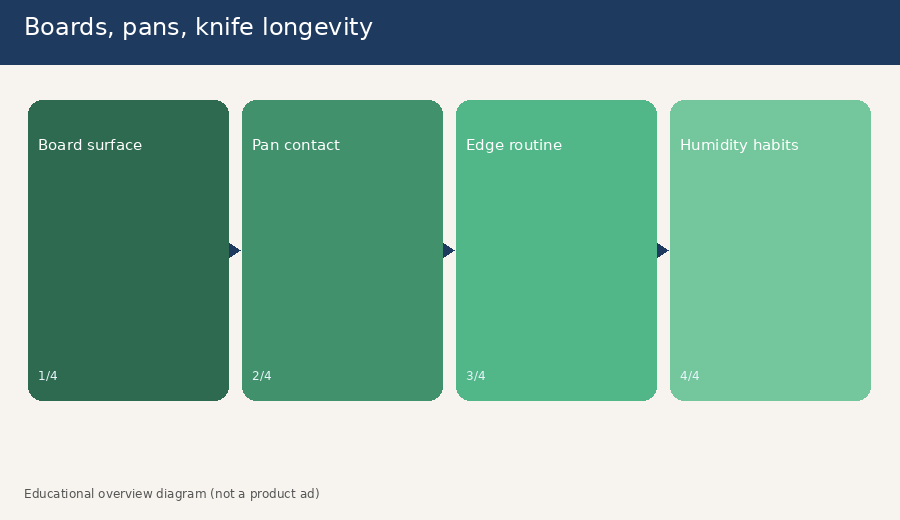
Board, pan, edge routine, humidity. Four places longevity is won or lost.
How boards and pans decide knife longevity
The surface under the blade matters as much as the blade itself. Wood and plastic give a little; glass and hard stone punish the bevel. Stabilize whatever you use with a damp towel so the board cannot skate toward the hob. Food safety sits on the same surface: USDA FSIS cutting board guidance still recommends separate boards for raw meat and ready-to-eat food when you can manage it, plus hot soapy washes and thorough drying. In Singapore humidity, drying is not optional.
Browsing a wooden chopping board for humid flats is useful for sizing a board that fits beside the sink without dominating the counter. Measure first. A huge carving slab that never leaves the top shelf does not protect your edge.
Pans matter too. Soft nonstick coatings hate metal scrapes; a metal spatula dragged hard across a soft surface shortens both pan and patience. Stainless steel pans that survive metal utensils tolerate more contact when you cook carefully, but gouging any surface still chips an edge. Keep knives for the board. Use silicone or wood tools when you are protecting a nonstick layer, and reserve stainless for searing and fond when you want metal contact that will not shred a coating.
A starter shortlist for Singapore weeknights
Pick one path and stick with it for a season. Either buy one chef knife you will use daily, or a three-piece starter set with chef, bread, and paring shapes. Pair it with a stable wood or plastic board, a honing habit, and cookware that matches how you scrape and stir.
Good knife buying in Singapore is less about collecting steel and more about matching space, humidity, and dinner habits. Protect the edge on the board and at the pan, dry everything before bed, and the first blade you choose will still feel trustworthy months later.
